
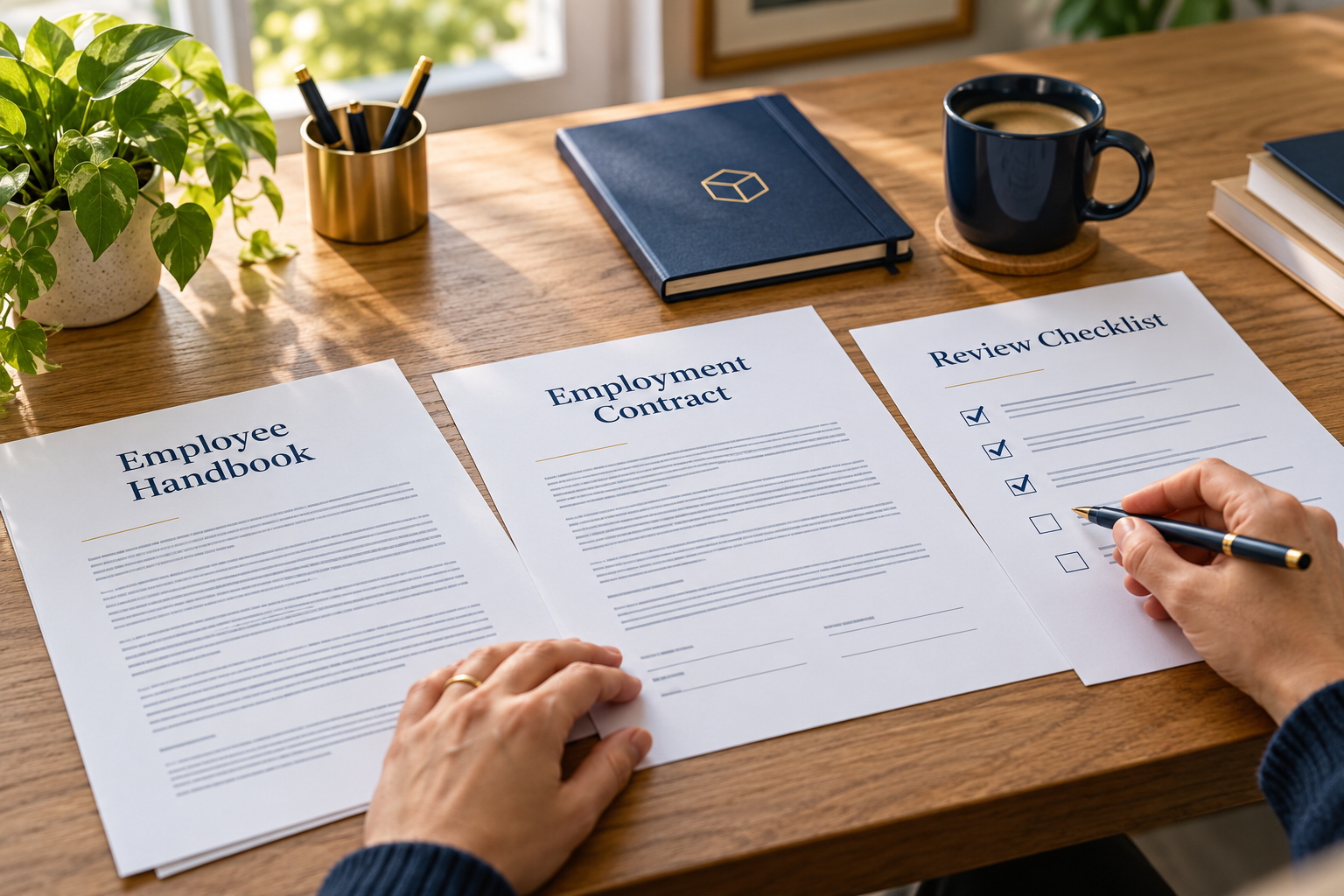
When did you last properly review your employee handbook? Or check whether your employment contracts reflect how your business actually works today?
For many growing businesses, these documents were written when the first few people joined, updated when something went wrong, and carried forward ever since. They might contain an old company name, a process nobody follows or a benefit you stopped offering years ago.
The Employment Rights Act 2025 makes this a good time to take another look. The changes are still being phased in, so the sensible starting point is to understand what applies now, what is coming next and where your own gaps are.
1.What is changing and when
The government’s implementation timetable, updated on 25 September 2026, sets out these key milestones:
| Timing | Changes to keep on your radar |
|---|---|
| Already introduced in April 2026 | Statutory Sick Pay waiting days and the lower earnings limit removed; paternity leave and unpaid parental leave available from day one; strengthened whistleblowing protection relating to sexual harassment. |
| 1 October 2026 | Employment Tribunal claim time limits extended from three to six months. The Scotland employment contract claim change follows on 9 November. |
| 30 October 2026 | Stronger sexual harassment prevention duties, third-party harassment obligations and further trade union measures. |
| 1 January 2027 | Ordinary unfair dismissal qualifying service reduced to six months and compensatory awards uncapped. Fire and rehire protections are also scheduled for January. |
| During 2027 | Further reforms include flexible working, guaranteed hours, bereavement leave and enhanced protections for pregnant employees and new mothers. |
Future dates remain subject to parliamentary processes and some details still need to be finalised. Day-one leave eligibility should also not be confused with eligibility for statutory pay.
Source: Government implementation timetable.
2. Start with the documents people actually use
A handbook review should be more useful than replacing a few dates and adding another policy.
Look at whether employees can understand their entitlements, whether managers know what to do and whether the wording matches your contracts. Check sick pay and family leave provisions, grievance and disciplinary procedures, and harassment reporting arrangements. Identify what needs updating now and what should be revisited when the remaining rules are confirmed.
Contracts deserve the same attention. Are the terms consistent across your team? Are working hours, pay, benefits and notice arrangements clear? Do they reflect the agreements you have made as the business has grown?
Where changes affect existing contractual terms, plan the consultation and agreement process before issuing replacement documents.
3. Make probation a process you actually manage
The forthcoming six-month qualifying period is a reason to look closely at your early employment processes.
Do new starters know what good performance looks like? Are managers giving useful feedback early enough? Are probation reviews booked, completed and recorded, or postponed until somebody remembers?
My practical recommendation is to build clear expectations and regular check-ins into onboarding, with time to address concerns before the final review. A probation clause on its own will not make difficult conversations easier. A longer probation period will not postpone statutory rights either.
4. Help managers put the policies into practice
Updating your harassment policy is one part of the work. Think about the situations your employees encounter, how they can raise concerns and what managers should do when they receive a report. Include interactions with customers, clients and other third parties in that review.
The same principle applies across your people processes: a well-written document needs a workable process behind it. A short manager briefing, clear templates and an agreed escalation route can help turn updated policies into everyday practice.
5. Give the work a clear scope
You do not have to tackle every issue at once. Start with a document and process review, prioritise the gaps and agree a manageable programme of updates.
Through Buzzqube, I can support a one-off piece of work covering employment contracts, employee handbooks, individual policies, onboarding and probation processes, or a practical briefing for your managers.
We can agree the scope, deliverables, timing and price before work begins, whether you need a focused update or a wider refresh.
If your people documents need some attention, email angela@buzzqube.com and we can work out what would be most useful for your business.