
The Chancellor delivered the Autumn Budget this week, promising to give businesses some much-needed breathing space.
There weren’t too many nasty surprises for employers, which I’m sure will come as a relief to many. However, there are some important announcements that businesses should be thinking about as they plan for 2027.
Much of the attention has understandably been on the increase in the National Living Wage. But for me, three things stand out: pay compression, pay transparency and the changing approach to attracting and retaining good people.
These aren’t separate issues. They’re closely connected, and I think employers need to consider them together.
Here’s my take on the announcements and what they could mean for your business.
1. National Living Wage increases — but what about everyone else?
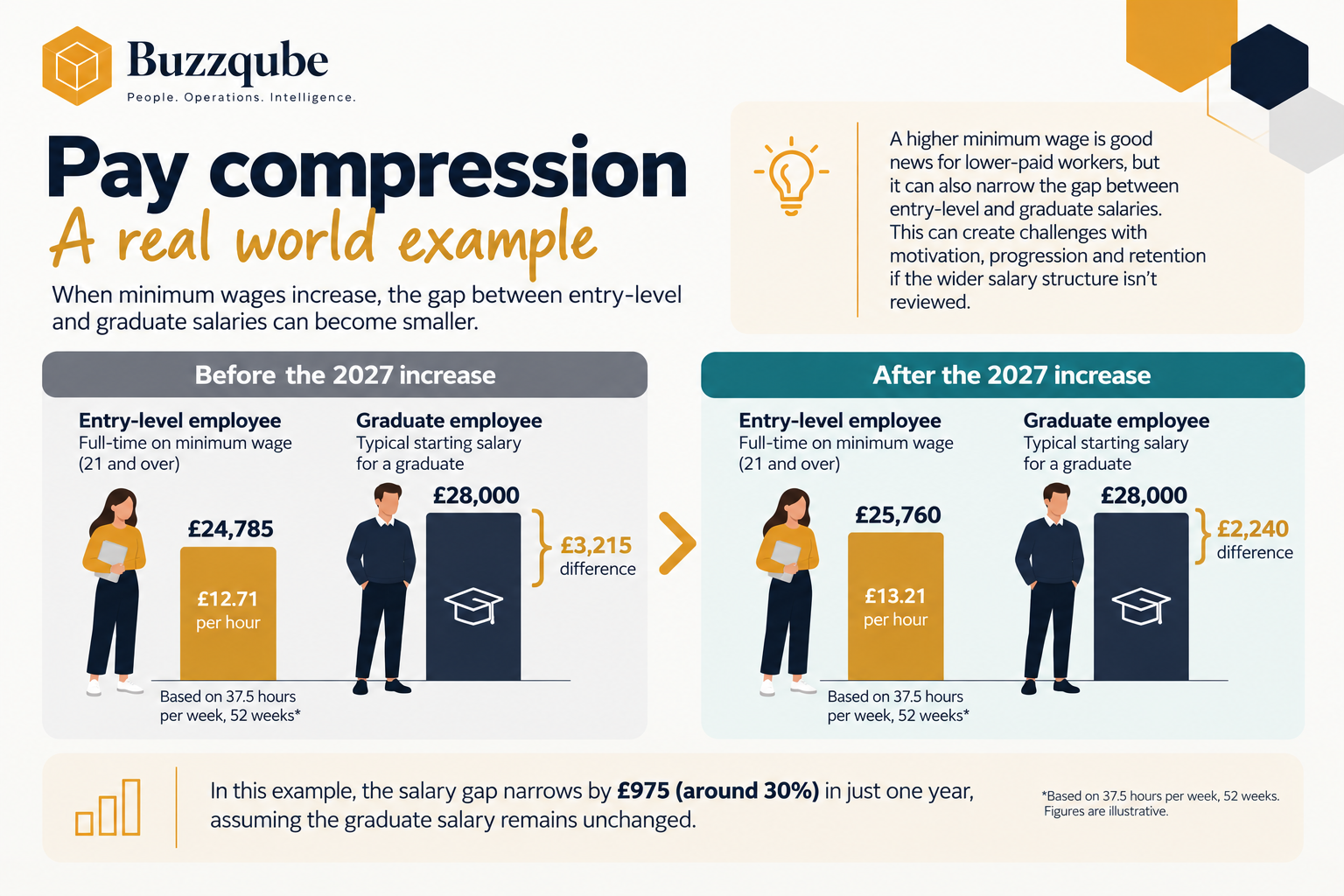
From 1 April 2027, the National Living Wage will increase by 3.9%, taking the hourly rate for workers aged 21 and over to £13.21.
The other minimum wage rates will also increase.
| Age group | Current hourly rate | From April 2027 |
|---|---|---|
| 21 and over | £12.71 | £13.21 |
| 18–20 | £10.85 | £11.27 |
| 16–17 | £8.00 | £8.31 |
| Apprentices | £8.00 | £8.31 |
The increases are welcome news for lower-paid workers, particularly given the continued pressure on household finances, but there’s a wider challenge for employers. As I mentioned in a LinkedIn post earlier this week, one of the things I see regularly when working with businesses on their salary structures is the gap between entry-level salaries and those of more experienced employees becoming increasingly narrow. It’s easy to focus on ensuring everyone is paid at least the new minimum, but what about the employees who have developed their skills, taken on additional responsibilities or progressed into more senior roles? If salaries at the bottom increase while those further up remain unchanged, businesses can find themselves with very little differentiation between roles. This is known as pay compression, and it can create problems with employee motivation, progression and retention.
There’s also the overall cost to consider. An increase in salary doesn’t just affect basic pay. Employer National Insurance and pension contributions need to be factored into workforce budgets.
What should employers do?
Rather than simply updating the salaries affected by the new minimum wage, take the opportunity to review your wider salary structure.
Are there clear differences between roles and levels of responsibility? Do employees understand how they can progress? Are salaries consistent and fair?
These are important questions regardless of the minimum wage increase.
Source: UK Government — Low Pay Commission recommendations for 2027
2. Pay transparency — are businesses ready?
Another interesting development is the government’s commitment to greater pay transparency.
The Chancellor has signalled plans to introduce salary transparency in job advertisements, although the detailed requirements and implementation timetable have yet to be confirmed. The government has also published guidance encouraging employers to be clearer about how pay, promotion and reward decisions are made. Personally, as a woman, I think greater transparency is a positive step, but it could also be uncomfortable for businesses that haven’t reviewed their salary arrangements for some time. In my experience, salary inconsistencies rarely happen overnight; they develop gradually as businesses grow, recruit new people, respond to market pressures and make individual decisions about pay. Before long, you can find employees doing similar jobs on quite different salaries, sometimes without a clear explanation for why.
Greater transparency has the potential to bring these differences into focus and it’s not just about putting a salary range on a job advert. If you’re advertising a role at a higher salary than an existing employee earns for similar work, you need to be prepared for questions. Employees will quite reasonably want to understand how their pay is determined and what they need to do to progress. That doesn’t mean everyone doing a similar job must receive identical pay. There can be legitimate reasons for differences, including responsibilities, experience and performance. The important thing is being able to explain those differences consistently and fairly.
What should employers do?
Start by reviewing your existing salary arrangements.
Do you have clearly defined roles and salary bands? Are decisions about starting salaries, pay increases and promotions consistent? Can managers explain how pay decisions are made?
You don’t need to wait for new legislation to establish a more transparent approach.
In fact, getting ahead of this could help build trust with existing employees and make recruitment easier.
Source: UK Government — Increase transparency for pay, promotion and rewards
3. Employee retention — could non-compete reforms change things?
The Budget also confirmed plans to reform non-compete clauses in employment contracts. These clauses are commonly used to prevent employees from joining competitors for a specified period after leaving an organisation. The government’s intention is to make it easier for people to move between employers, particularly into start-ups and growing businesses. Detailed proposals are expected in early 2027, with legislation to follow.
There are two sides to this:
For businesses struggling to recruit experienced people, fewer restrictions could open up opportunities to attract talent.
For employers concerned about losing key employees to competitors, the changes may be less welcome.
Of course, the detail will matter, particularly around protecting confidential information and legitimate business interests.
But I think there’s a wider point here.
If your main approach to retaining good people is making it difficult for them to leave, perhaps it’s time to rethink your retention strategy.
Employees stay for lots of reasons. Fair pay matters, but so do opportunities to develop, good leadership, interesting work, flexibility and feeling valued. Restrictive clauses may have a place in protecting legitimate business interests, but they shouldn’t be a substitute for creating an organisation where people actually want to work.
What should employers do?
Keep an eye on the consultation and review your existing employment contracts when the details become clearer.
In the meantime, think about what makes people stay in your organisation.
Do you understand why employees leave? Are there genuine opportunities for progression? Is your reward offering competitive?
Retention should be about more than preventing people from moving elsewhere.
4. What else was announced?
There were several other announcements worth highlighting.
Apprenticeships and youth employment
The government has confirmed £100 million over two years to support local apprenticeship services in England, helping young people connect with employers. It’s a welcome investment, although rising employment costs may still make some businesses cautious about creating entry-level opportunities. Employers should consider how apprenticeships and early-career recruitment fit into their longer-term workforce plans. Apprenticeship funding arrangements differ across the UK, so Scottish employers should check the support available through the Scottish system.
Employee share incentives
There was some positive news for growing businesses. The government announced changes to employee share schemes, including the expansion of the Company Share Option Plan, now branded EMI2. From April 2027, the individual tax-advantaged option limit will increase from £60,000 to £120,000. For eligible businesses, share incentives can provide another way to attract and retain talented employees, particularly where competing on salary alone is difficult.
Specialist tax advice should be taken before introducing a scheme.
Source: UK Government — Enterprise Management Incentives and EMI2
Business mileage allowances
The government has confirmed that the increased tax-free mileage allowance of 55p per mile for the first 10,000 business miles will become permanent. From April 2027, the rate for mileage above 10,000 miles will increase from 25p to 35p. Employers aren’t legally required to reimburse employees at these rates, but it’s worth reviewing your expenses policy and considering whether your arrangements remain appropriate.
Parental support
From April 2029, the government plans to extend parental financial support to eligible self-employed fathers, partners and adopters. Although this isn’t a new employer-funded entitlement, it’s another positive step towards supporting working families.
5. What should employers be doing now?
There’s no need to rush into making changes following the Budget, particularly where the government has announced proposals rather than confirmed legislation.
However, there are some sensible steps employers can take.
⭐ Review your salary structures. Consider whether increasing minimum wages will create pay compression or inconsistencies between roles.
⭐ Prepare for greater pay transparency. Make sure you understand how salaries are determined and can explain differences fairly.
⭐ Review your approach to retention. Think about what makes employees stay and whether your reward, development and progression opportunities remain competitive.
⭐ Update your workforce budgets. Factor in the April 2027 wage increases alongside employer National Insurance and pension costs.
⭐ Check your policies. Review mileage reimbursement arrangements and keep an eye on the forthcoming consultations and legislation.
⭐ Think about the bigger picture. Consider how these changes interact with the wider employment rights reforms already approaching.
A final thought
What stands out to me from this Budget is how closely connected these issues are. Increasing wages affects salary structures. Greater transparency brings questions about fairness. And changes to non-compete clauses could make retaining good people more challenging. Looking at each announcement in isolation risks missing the bigger picture. For employers, I think the real opportunity is to step back and consider whether their approach to pay, recruitment, development and retention is working as a whole.
Because ultimately, having a fair and consistent approach to your people is good for employees and good for business.
Need a hand?
At Buzzqube, we work with businesses to develop practical people strategies, review salary frameworks and improve recruitment, reward and retention.
We also use AI to work smarter, bringing together technology and people expertise to deliver practical, efficient solutions.
If you’d like to discuss how these changes could affect your organisation, we’d be happy to help.
People. Operations. Intelligence.
30 October 2026 | Buzzqube Insights